"Tirigochha’s installation was in total flow. From a perfect weather day to luck on crossing 7 streams and 4 rocky slopes…and returning without weather and road complications, to the beautiful village spirit, with the women blossoming from buds of curiosity to full grown hands-on interest and confidence, supported by their male counter parts and children; to the village taking the systems in as their own, coming up with new ideas to make them work better; to not just having individual interest but helping each other. Not sure whether it’s the size and/or heart of the nearly perfect 10-home village."--Journal entry, June 9, 2006.
Coined by Jos, micro solar refers to a solar home ligting system that has WLED (white light emitting diode) lamps instead of CFL lamps. Because LEDs consume little power (1-3 watts giving enough lumens to read), the panel and battery size become small, along with the cost! Micro solar systems cost Rs. 2500 - Rs. 4000, while full fledged solar home lighting system (power 2 11-17 watt CFL lights) cost around Rs. 15,000, simply because of the larger panel and battery.
The units we are using are supplied by a non-profit organization called Grameen Surya Bijlee. The founder of the company, a compassionate industrialist in Mumbai, has long been facilitating eye operations for rural communities with some friends. During the visits to the village homes, he realized one reason they the villagers have eye problems is the lack of light and the effects of using kerosene. Hence, he founded the Grameen Surya Bijlee Foundation (GSB). He has been excellent in taking our input to improve their systems. GSB is selling the lights only to non-profit groups working in rural/remote areas. For the urban market, GSB has come up with AC LED lights. Of course the debate is whether the LED light is enough. More info at: http://www.suryabijlee.com/
Thanks to Jos' push on giving the systems a try for the cost and portability benefits, I had enough confidence to recommend Gram Vikas to do a pilot project. Below are photos and the steps of the project...not completely flawless but definitely a smooth and positive experience. Two pilot projects with a total of 25 units were installed. Yes, a small project, but with your ideas maybe it can affect others in even better ways. Looking forward to your thoughts!

First we visited the village with demo units and questions on whether they really needed and wanted the micro solar systems. We made sure men and women from rich and poor families were given the space to express their thoughts...still one wonders whether there are some that do not express.

Everyone was wowed by the demonstration and all agreed to committ to the Gram Vikas agreement. Even though the villagers are wowed by the units, it is up to us to help make aware to them that the lights should be useful to them. If they have other priorities for their funds, e.g. medicine, food, then the NGO should help create a community fund from the village contribution for the systems that would address urgent and unplanned needs for money.

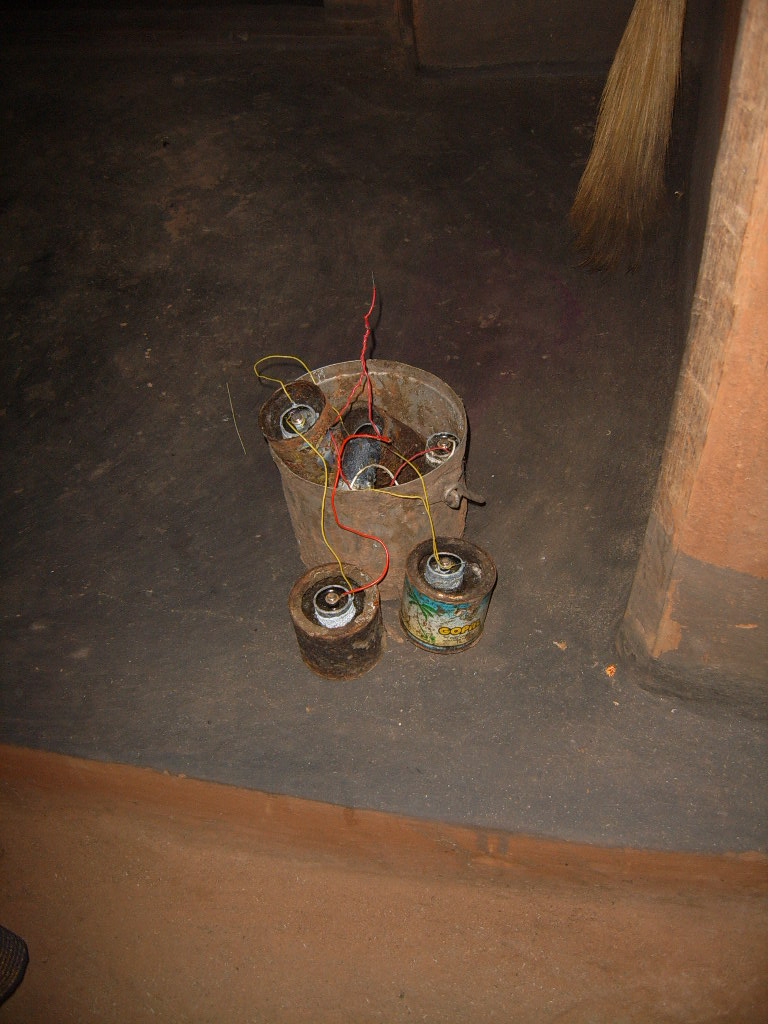
During this initial visit, we went to each home to see what they currently used for light. New discovery: charging alkaline batteries using cow dung!

In every region it is always interesting to discover the local livelihoods...like this artisan who's been weaving Sambhalpuri saris for 30 years. ...Wonder who made the machine!

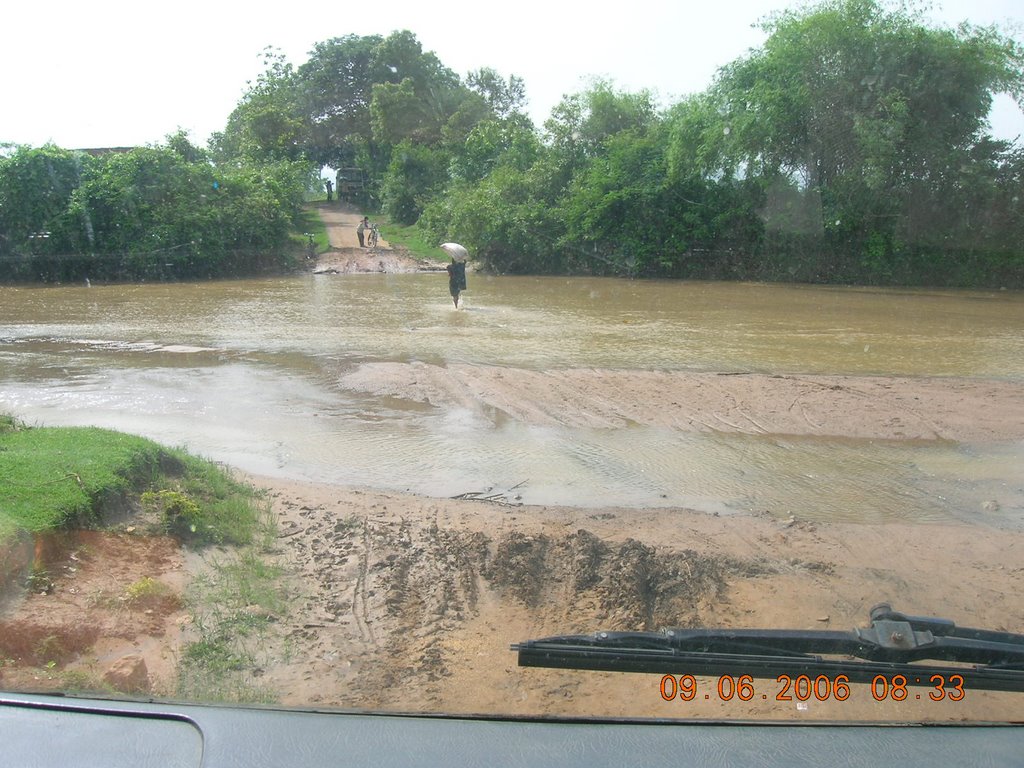
Once a verbal agreement was reached during the initial visit, we set out with the equipment, hoping that it, especially the panels, arrive in one piece. There are various road obstacles—local traffic...

...crossing muddy waters,

...and preventing flat tires.

Upon reaching ther village, a formal agreement was signed. Yes, all the men and women of this village could write their names; and they trusted our reading of the agreement to them. Gram Vikas is experimenting on various financing models by giving a subsidy of Rs. 1600 to each household.
The community agreed to pay Rs. 1000 for the system and Rs. 20/month towards a maintenance fund. The fund would become a service fee for 2-3 community members who are more thoroughly trained to maintain the system, e.g. replace batteries after 3 yrs.
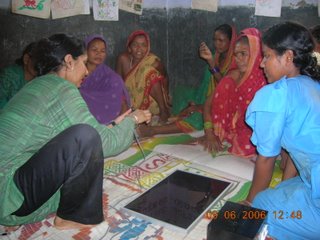
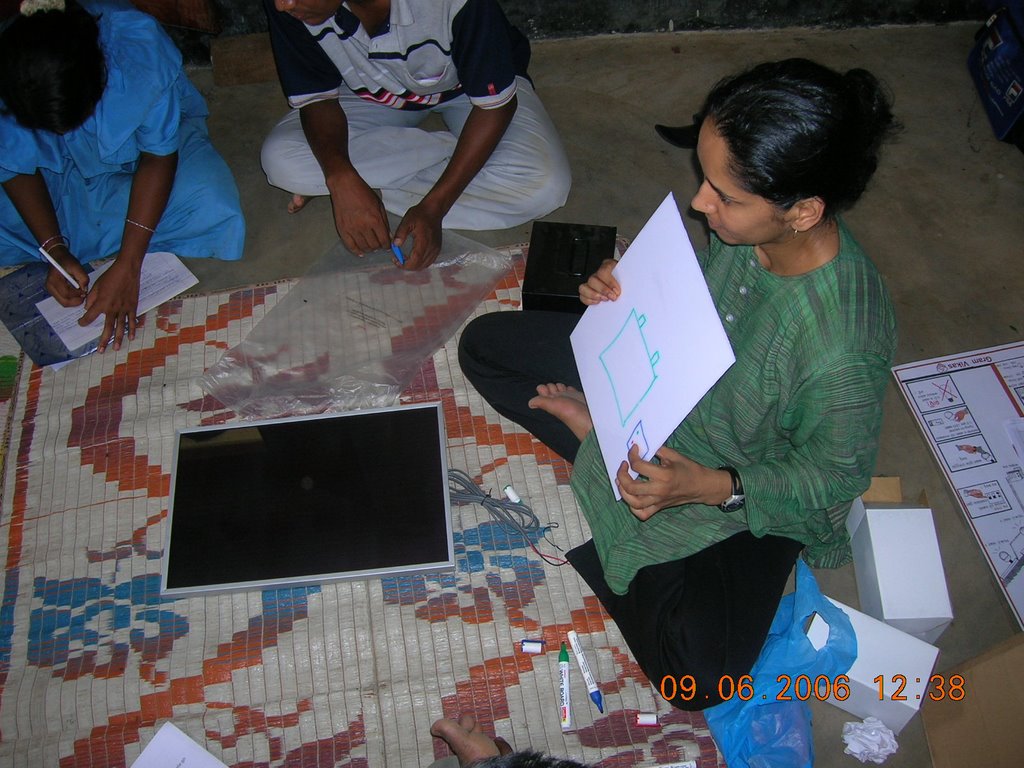
The installation and the training started with having a head to heart session with women from each household. Since they are home more often than their husbands, the women need to know how the systems work, are installed, and how to trouble shoot. The training starts with simple vocabulary and pronunciation: “battery, controller, control box, solar panel, and light”.

Next, we go into basics of each component, especially why the charge controller needs to be the boss and how the sun affects charging.

Yes, I've finally learned that women's issues and involement cannot be improved unless there is equivalent involvement of the men!

Though I have to say that once taught, women are far more diligent in completing the task. I thought these ladies would a an hour at least to connect a few systems for practice....
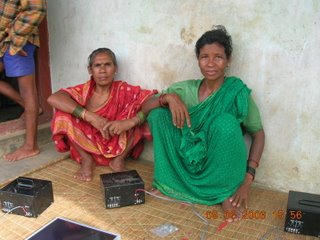
....They were done in 15 minutes and chilling out afterwards!

The installation must actively involve the community. If at all possible, the community should do the actual installation so that they learn how to handle the system.
However, even before the installation, design work should also take in community input. Each household (leading man and woman of each family), after being taught how the sun and wire lengths affects charging, decided the panel, lights, and control box locations, based on their home's layout and their specific need for light. Some families placed lights outside for the porch, some in the kitchen, and some in storage areas. Letting each family decide these locations, taking into account technology design constraints (point the panel south) increase the sense of ownership of the systems. There prevents villagers from taking a passive attitude or selling components should the unit malfunction.
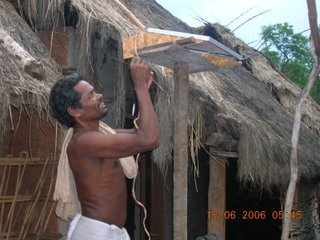
For the mounting of panels, the community had been worried about theft. Hence, we designed the mount such that it can be brought out in the morningand take back into the home in the evening.
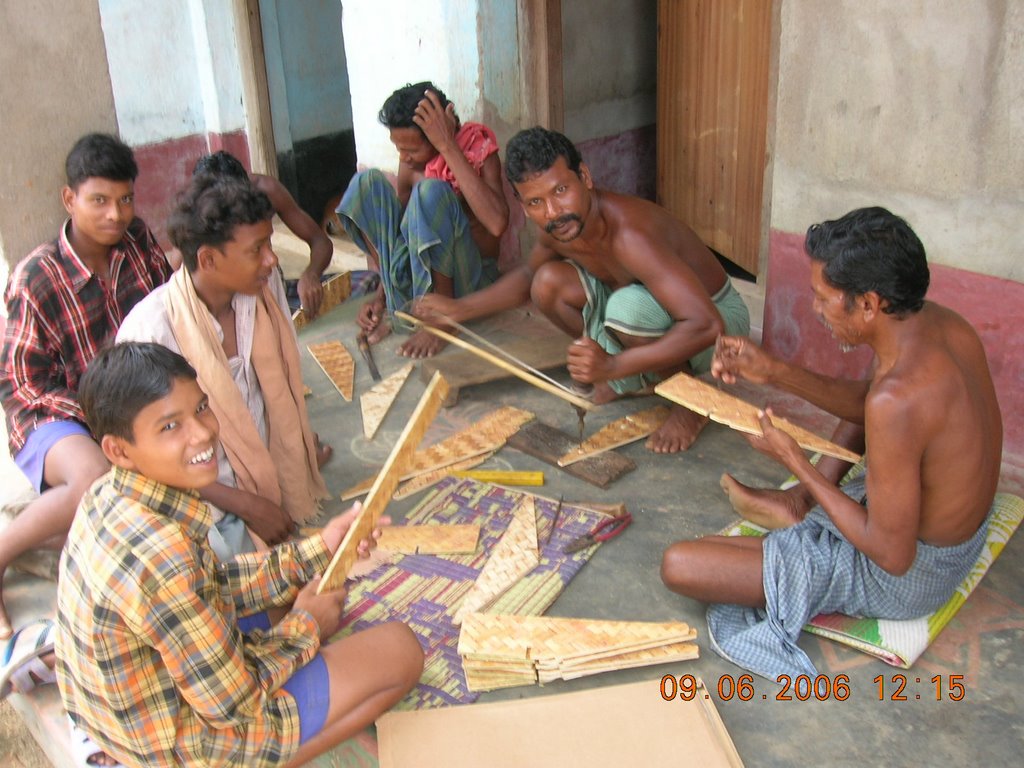
We pre-designed, and pre-fabed the rack that holds the panel (it's made from a material called plyboo made from bamboo). Ideally, it would have been nice to have the villagers design it from scratch, but I had to somehow convey that some type of rack to handle the panel was needed since it would be moved twice a day to prevent theft.
However, the design of actual pole and part of the mount that stays outside was left to each household. This helped to make the installation their own effort and own accomplishment, giving more chances of them taking care of the installation. It also helped to address that not every family has the same natural resources to build an identical mount

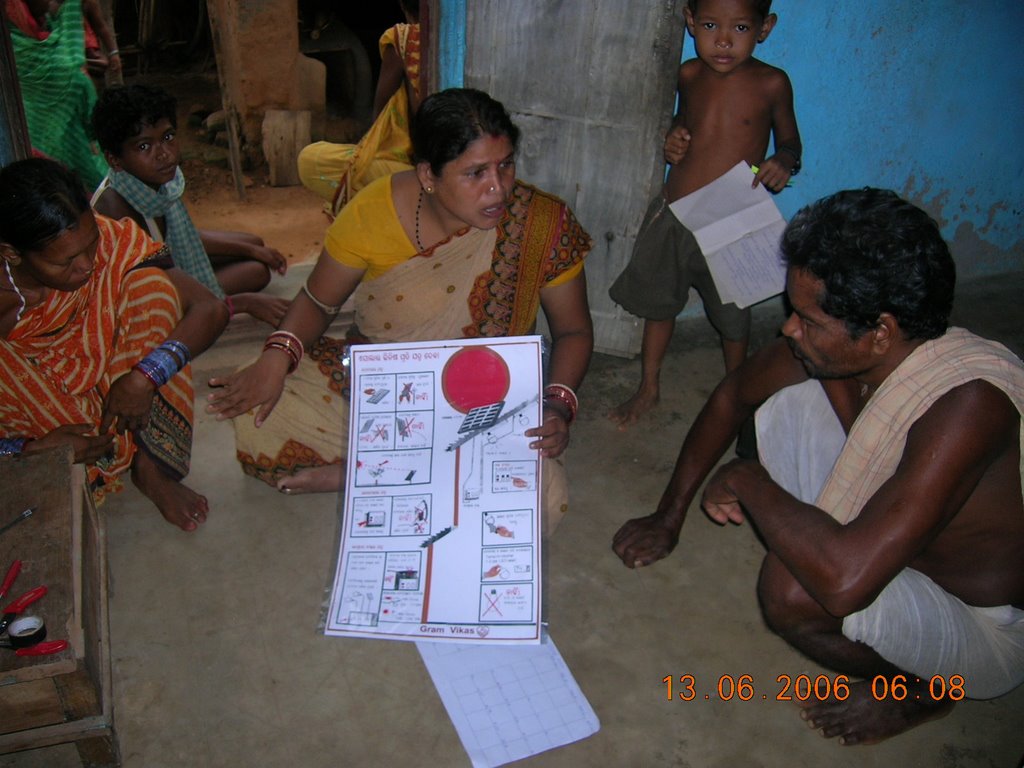
Thanks to Green Empowerment volunteer Drew and my friend mark...AND the Gram Vikas art section, we were able to make a pictorial training tool that is left with the villagers as reminder on how to install and train.
...In the US, Kinko's rocks...here, this poster took unbelievable effort to produce with just manual printing methods.

After the installation and maintenance discussion with each household, each family completed their own installation. The woman of household connects one light...having participated in the women's group training, by this time the ladies had full confidence in installing in front of their presuming husbands.

...All smiles upon hitting the switch and seeing the light turn on.

The man of household connects the second light. (Yes, we were not using a safe screw driver...long story on why no other choice that day.)

Each family took it upon themselves to keep the installation neatly maintained. Each one had their own way of keeping the box away from falling items and heat in their small homes.

The next morning, when a couple of batteries were not charging, with a little encouragement the ladies did the troubleshooting themselves and solved the problem!!! ...I couldn't have had a better birthday present.

(That's Yaniis, an all-star volunteer from Canada, in the middle...not an abnormally tall and fair tribal!)
With simple steps in involving the community, the lights simply become an excuse to bring dignity to marginalized communities.
-----------------------------------------------
In the horizon is nearly a flawless project: Colorado College sponsoring micro solar units to a 70 home village which after 8 years has been transformed from a village that had deaths from malnutrition to a village that has a healthy community grain bank and community fund. The villagers have agreed to pay full cost for the systems, and for those who cannot pay full cost the community fund will give a loan so they have more time to gain ownership of the system. The pluses of this scenario:
-Colorado College will sponsor the units, so the villagers money can go to the community fund
- It's always an internal debate on whether we are taking away something by giving them lights and having them contribute something towards them; but in this case, the community fund can address maintenance, medicinal, or other needs for money.
-Students from Colorado College will train each family to install and maintain their own units, allowing an exchange of perspectives and cultures. The students will live with the villagers.










 Upon reaching ther village, a formal agreement was signed. Yes, all the men and women of this village could write their names; and they trusted our reading of the agreement to them. Gram Vikas is experimenting on various financing models by giving a subsidy of Rs. 1600 to each household.





 (That's Yaniis, an all-star volunteer from Canada, in the middle...not an abnormally tall and fair tribal!)
