Friday, July 21, 2017

New Bloom


It was 12-years ago when I started this blog, thanks to Yoo-mi and Mark's timely nudge.  The last few years I'd nearly forgotten it exists.  Today I crossed its path again, searching for photos of the Shinko La Pass and re-called I had posted some.

The blog is a literal time-machine, one that takes me back to the start of a rich inner and outer learning journey -- On Fire, She Answers, Christmas Eve, and Not Even a Glance.

But it's a heart and mindset that seem unattainable now.  Too many deadlines.  Too many causes to care about. Too much information.  Too much heartbreak.  A few too many decades -- I turned for 40 this year. :)

Perhaps I'm wrong. Maybe it is attainable, but the required speed of absorbing experiences now is too fast. The illusion of never enough time to reflect, introspect, share.

Since my last post, I've worked in endearing corners of south/southeast Asia, albeit often only to spend time with my laptop :), but getting in some micro hydro visits, and precious moments with awe-inspiring ground-level practitioners.

What makes me re-connect with Inner Urja?  At 2:30am Yangon time? :)  I'm not sure.

Amidst the heavy writer's block, it seems unreal that I could have nurtured a blog.  The inner waves were rough then too, but in the earlier posts I sense complete presence and deep compassion to everything that comes.


I accept that I cannot go back to being the person I was 12-years ago.  And why desire so?

Just like the Brama Kala that blooms at midnight and only once in that life, that Dipti remains only in the form of transformed energy, passed onto the next moment.

What matters is Now and how present I am to it.

If I listen closely to the rhythm of the monsoon rain, the stillness of the early morning to come, the dhamma that imbibes this city,

If I note the random waves of stillness, anxiety, and Grace within,

I'll see that I'm always blooming.  May we all keep blooming.


Sunday, January 22, 2012

Field Trip with Gram Vikas Management


Gram Vikas Project Offices in Kalahandi

Narahari Babu's "svarg' at the Baffala project office, prolifically demonstrating organic farming methods for nearby villages.


Chicoooo!

Nearby village youth being trained in masonry work.


Monday, January 16, 2012

Thursday, December 15, 2011

Hunnar Shaala

Hunnar Shaala is one of my most favorite NGO's, led by a Sandeep Virmani and Kiran Vaghel and several other phenomenal managers. They focus on indigenous building/construction methods and water management and many other interventions for rural and urban marginalized communities. The thread that links all their work is that they want to learn from locals and help them see they already know what is required.

My sister has been working there for a year now. I just visited their office and her work in the slums of Bhuj.

Hunnar Shaala has a website (http://hunnar.org/) but I think it could do a much better job of showcasing all their excellent work. Anyone interested in helping them update their site?


They have a beeeeautiful new office that uses the building techniques they promote.


Kiranbhai (who helped greatly with some innovative Kalahandi work) and I share a laugh near their new workshop.


We're standing next to a rammed earth wall.


Another one of Hunnar Shaala's strength is to network effectively and efficiently with other groups to make lasting changes. Here is a community worker from KMVS that works with my sis facilitating slum housing in Bhuj.

Transition back to Bhawanipatna

Time goes,
Settings change,
Eyes, heart, mind rest.
All looks new...again.

Feels good to be back ... and adjusting.


Been nice to catch up with buddies in town. Here's Kumari. She's been sweeping for Gram Vikas for some time now. Her husband left her years ago. She has two beautiful kids and a gorgeous smile, melodious voice, and huge heart.


Here is Podur, one of my many favorite cycle rickshaw-walas. The best part about Bpatna is that there no autos! (Well, i did see one before I left in Aug.)


And the best part of town are the daily and weekly market scenes (taken from Podurbhai's rick).


Friday, September 02, 2011

Switzer Fellows 2011

Woohoo! I just experienced an incredible rush of inspiration reading about this year's Switzer Fellows!

Saturday, April 30, 2011

The Law of Mother Earth

In theory, Bolivia's "Law of Mother Earth" is impressive. I hope it indeed brings benefits for Pache Mama and all of her inhabitants!

Wednesday, April 13, 2011

Wednesday, March 09, 2011

The Universe Answers

In the Bijapada cluster, we have met a couple of villagers that have severe skin issues. Both patients are immobile, making it difficult for us to bring them out of the canyon and into a hospital. Also, their families say that they had earlier visited the hospital but their health did not improve.

...At first site of their skin illness, one cannot help but want to do something drastic and immediate. Their conditions look so very painful. Life would be so depressing. It's depressing to just see these guys. Every time I visit them, I visit Patient 1 first, since his hamlet comes first on our walk from the powerhouse site. I go thru the usual emotions; by the time I reach the next hamlet, I've almost forgotten the sadness. But then I encounter Patient 2 and the emotions rise again. ...Further depressing is that Patient 2's 16-year old grandson also has increasing areas of numbness on his limbs. ...What is the disease? Is is contagious? How many more people have it? What can we do? ...How can they just keep living day after day, dealing with it as it is?

Finally the Universe answers: Thanks to my friends Naman and Sri-- both phenomenal doctors working on developing country health issues--there is now a path in sight to address Patient 1 and 2's illnesses. Sri and Naman have connected us to specialists in the US and in Orissa who are willing to help diagnose the skin conditions, if we can get a few tests done. Local doctors are also very interested to help. ....We just need to make it happen....soon!


New Micro Hydro Project: Punjam

In parallel to the Bijapada project, we are implementing the Punjam project in Lanjigarh block of Kalahandi district. Punjam differs from Bijapada in various ways which affect our work:

Hamlets
Although both villages have multiple hamlets, Punjam's hamlets are densely clustered, while Bijapada's four hamlets are kilometers apart from each other, making it more challenging for the community to organize itself.

Distance and Accessibility from Main Road
Although it takes us 2.5 hours to drive to both villages, Bijadapada requires several extra kilometers of walking/hiking. In addition to its hamlets being scattered kilometers apart, Bijapada's nearest motorable road is 2km away uphill. We love hopping and skipping down the canyon...but getting back out is often a workout, especially after a full day of walking to each hamlet...sometimes twice! Accessibility to the village are affecting the project budget, in terms of transporting materials to the village.

Number and Diversity of Households
Bijapada has around 50, fully tribal households, while Punjam has over 110 households, 90% of which are tribal. A smaller number of households makes it easier to recognize the main characters in the village and understand its social dynamics more quickly. Facilitating a larger village, mixed ethnicity village requires more diplomacy.

Village Wealth
While the 10% non-tribal households are a minority in Punjam, they are certainly the face of Punjam. The non-tribals are factors wealthier than the tribals. The wealthier households have activities outside of the village, making it easier for them to confidently communicate with us. For example, Punjam's wealthiest household (not surprisingly non-tribal) owns a tractor, half of the population does have land (according to what we have heard from certain villagers). While there is also some economic disparity in the Bijapada cluster, it is not as drastic. The wealth does not necessarily dictate leadership (as we have observed thus far) as it seems in Punjam.

NGO/Government Presence
While Punjam is frequented by NGO and government agencies, the Bijapada cluster has only the government watershed program (that we know of). This makes the community's response to us very different in both villages.

Civil Works' Level of Difficulty
While the power output for both project will be about 15kW, Bijapada's civil works will be very challenging, due to high flow and stone areas. Thanks to Ranjit's last 10 days in the village, Punjam's straightforward civil works are nearly finished!

Here are some images of Punjam. (The 3 basic components of micro hydro civil works are: weir, channel, and forebay tank.)

Punjam's small but beautiful water source:


Punjam's weir structure:


Punjam's channel:


Punjam's forebay tank in progress:


Friday, February 25, 2011

New Micro Hydro Project: Bijapada

Nestled amongst a beautiful canyon and its multiple streams is the site of our new micro hydro project, the Bijapada village cluster (50 households) in Thuamul Rampur block, Kalahandi district, Orissa. We are grateful to Christian Aid for supporting our work at this site and to Antodaya for suggesting Bijapada village.


Since November, it's been quite a journey in understanding the psyche of this relatively remote tribal community. In the next few posts, I will try to describe our journey thus far, in ensuring that the project is community-led, rather than NGO-led.


Time to time, I will invite local technicians, engineers, NGO staff, and community members to blog their experiences first-hand. For now, here are photos taken during the feasibility and design studies.

One side of the weir profile:


Other side of the weir profile:


We've had to think about how the weir will be anchored into the stone...

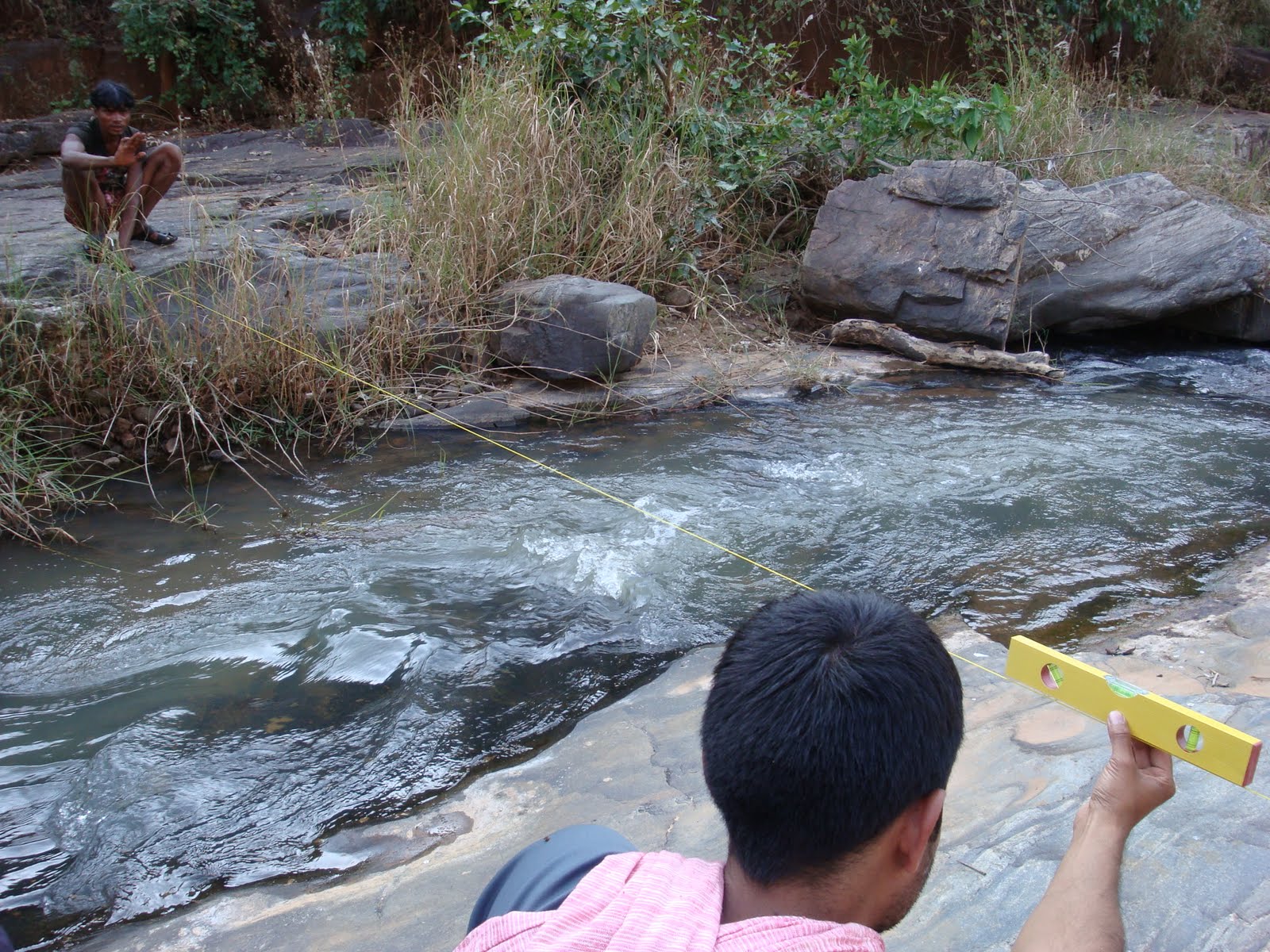
The water flow varies from 80-100lps, depending on the water use of the upstream village and seasonal changes:


Our new team member (holding the level) and an old friend, Ranjit Deshmukh, has been the technical lead for this project. With four existing projects to improve and implementing two new projects in parallel, needless to say, my plate has been full. Therefore, Ranjit's presence has been priceless in ensuring that we do not make technical mistakes (or at least do not repeat mistakes form earlier projects).

As a newbie to micro hydro implementation, Ranjit's key role is to learn from our Sri Lankan mentors and demystify the knowledge for the local team, consisting of technicians in Bhawanipatna (nearest town) and talented youth in the villages.


See the bamboo stick? The task of preparing the bamboo to use as a measurement tool became an opportunity for the village youth to bond with our team:


Richard Russell, a volunteer from the UK, helped with note taking:


A channel, likely made from HDPE or PVC pipe, will extend from the weir to the forebay tank:


The forebay tank will be located on top of the flat stone on the right:


The HDPE penstock will have to be routed from the forebay tank location to the powerhouse via the stone walls. ....Yes, challenging work ahead!


After the first 100m, the penstock will have a nice, boring path thru the woods and on soil...


...down to the powerhouse location:


During one of our visits, when all the adults were busy with their harvesting, 3 young guides were sent to make sure we didn't get lost. These three kept an eye on us the entire visit, whether nearby or from a distant rock.


Friday, December 17, 2010

Corporates

Can't live with them...and maybe without them. Here is an interesting article about the President Obama's recent meeting with CEO's.

http://www.huffingtonpost.com/robert-l-borosage/obama-and-the-ceos-lookin_b_797961.html

Thursday, August 26, 2010

Aloofness to Pakistan's Floods

"The United Nations has characterized the destruction caused by the floods in Pakistan as greater than the damage from the 2004 Asian tsunami, the 2005 Pakistan earthquake, and the 2010 Haiti earthquake combined. Yet nearly three weeks since the floods began, aid is trickling in slowly and reluctantly to the United Nations, NGOs, and the Pakistani government."

I visited Pakistan nearly 4 years ago to assist my mentor Walt Ratterman on a training. I loved every moment of the trip--from crossing the border via bus, to making new friends in Lahore, meeting old friend Islamabad, and getting to know Walt's colleagues and students.

...When the earthquake struck Pakistan, a couple of years before my visit, I was in India and made firm plans to "go help". Due to a family event, although I got a visa, I did not go then; and instead went later with Walt.

...Yet now, it has been 3 weeks and only now I am realizing the extent of the damage from the floods!! ...Only now am I doing the internet searches and contacting friends for un-biased information, from the field.

I feel like a hypocrite waiting so long to take stronger interest in the situation. Something about floods versus earthquake/tsunami that delayed my interest. I'd been following the situation-to-be in Afghanistan, but I became too busy this month for Pakistan.

I often argue for Islam when I hear biases against it. ...Realizing that others' biases against Muslims may have slowed aid for the flood victims ("Why Doesn't the World Care about Pakistanis"), I feel that I should especially be taking interest in the floods to see how we can help.

...I am still working on my thesis, hoping to get my sitar tuned tomorrow, planning my exercise regiment, seeing friends/family plan Labor Day breaks...all the while, an entire country is set back by decades.

Tuesday, August 17, 2010

Today's "Avatars"

Have you seen the movie Avatar? Do you have an Avatar story unfolding in your community?

Here is an example of an Avatar-like plot taking place in Kalahandi District, Orissa:
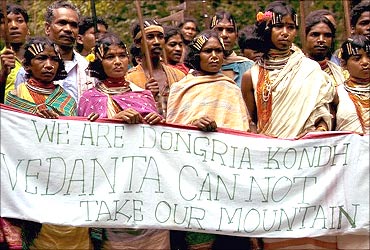
Vedanta's crusade on the sacred Nyamgiri Mountain


Do forward me any such real-team Avatar stories. Collecting today's Avatar incidents, on a single web space, to share with others maybe a useful resource for us to understand how our power as a consumer relates to lives around the globe (and maybe neighbor), e.g. purchasing products that support Corporations who are the root of real-life Avatar incidents.

If you know of such a web space already existing, please forward!

Sunday, August 15, 2010

Freedom and Courage

Aug 15--India's Independence Day. Two inspiring insights (click on the linked words)

1. Chhote Ustad 2010
Amongst the various TV shows on Indian tv, there is now an interesting music talent show that encourages India and Pakistan's young talent to team up. It reminds me of Friends Without Borders.

2. Neighbor's Bank Workers
"Ms Wu"has been courageously mobilizing Chinese bank workers to fight for their rights. ...Though the sad news is that Ms. Wu may now be detained for a while. Ms. Wu helps me feel the link between Freedom and Courage.

These two stories remind of the potential of and challenges to freedom in today's world.

Saturday, April 10, 2010

The Week in Review

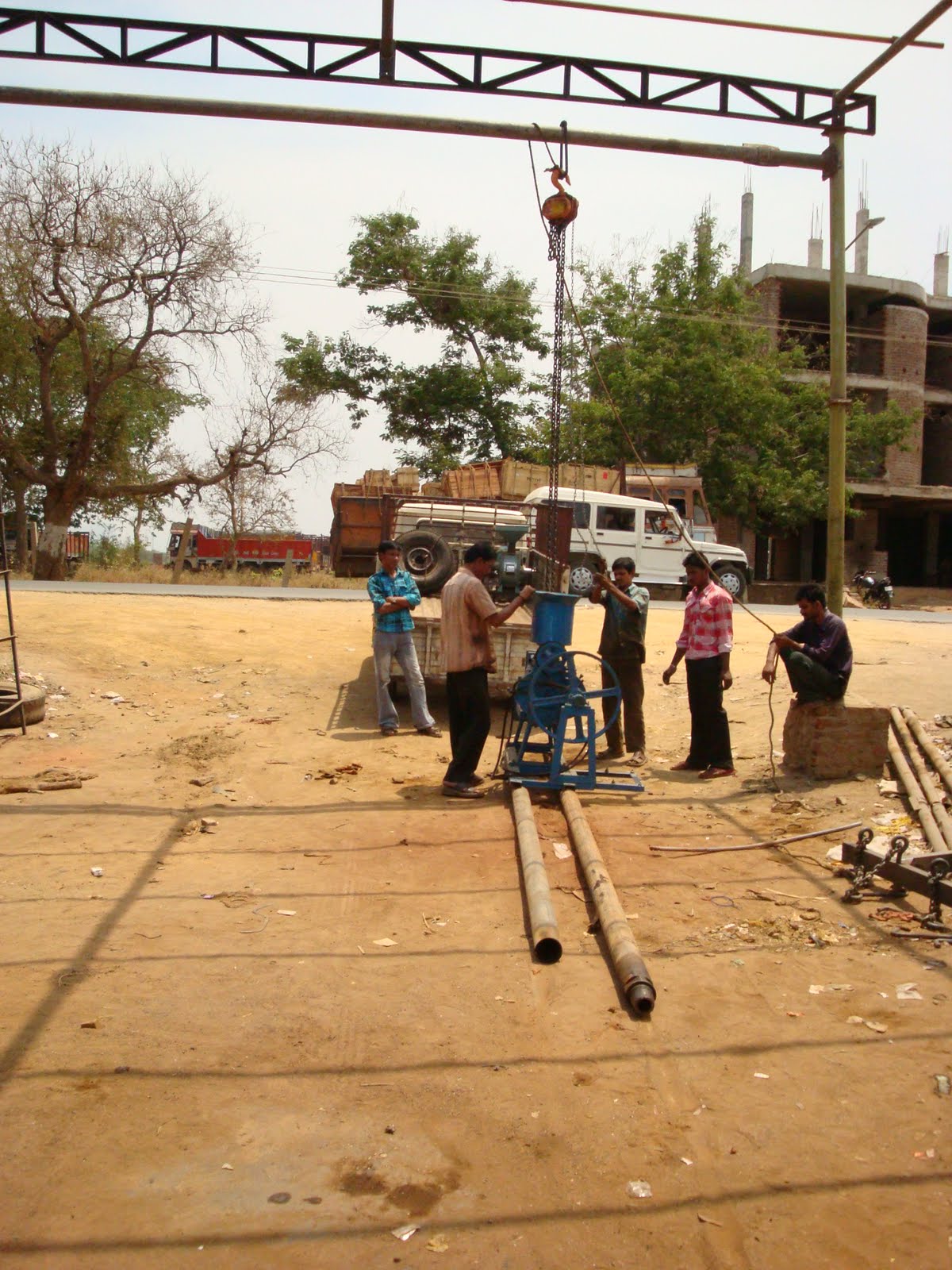
Lots of loading and un-loading this week in transporting oil presses from Bhawanipatna to micro hydro sites (electricity-based livelihoods activities).


At Amathagouda micro hydro, there is never a dull moment. Every time we fix one thing, something else goes wrong. Now that we've almost finished replacing the old school pulley to pulleys that are easier to remove, we discovered a pipe leak.


The leak is due to a dried up rubber gasket at a joint located between 2 beautiful anchor blocks, next to a mango tree. The system also needs a bypass line. So the solution: cut the pipe (instead of destroying the blocks) to change the gasked and add a bypass line.