Showing posts with label Micro Hydro in Kalahandi. Show all posts

Wednesday, March 09, 2011

New Micro Hydro Project: Punjam

In parallel to the Bijapada project, we are implementing the Punjam project in Lanjigarh block of Kalahandi district. Punjam differs from Bijapada in various ways which affect our work:

Hamlets
Although both villages have multiple hamlets, Punjam's hamlets are densely clustered, while Bijapada's four hamlets are kilometers apart from each other, making it more challenging for the community to organize itself.

Distance and Accessibility from Main Road
Although it takes us 2.5 hours to drive to both villages, Bijadapada requires several extra kilometers of walking/hiking. In addition to its hamlets being scattered kilometers apart, Bijapada's nearest motorable road is 2km away uphill. We love hopping and skipping down the canyon...but getting back out is often a workout, especially after a full day of walking to each hamlet...sometimes twice! Accessibility to the village are affecting the project budget, in terms of transporting materials to the village.

Number and Diversity of Households
Bijapada has around 50, fully tribal households, while Punjam has over 110 households, 90% of which are tribal. A smaller number of households makes it easier to recognize the main characters in the village and understand its social dynamics more quickly. Facilitating a larger village, mixed ethnicity village requires more diplomacy.

Village Wealth
While the 10% non-tribal households are a minority in Punjam, they are certainly the face of Punjam. The non-tribals are factors wealthier than the tribals. The wealthier households have activities outside of the village, making it easier for them to confidently communicate with us. For example, Punjam's wealthiest household (not surprisingly non-tribal) owns a tractor, half of the population does have land (according to what we have heard from certain villagers). While there is also some economic disparity in the Bijapada cluster, it is not as drastic. The wealth does not necessarily dictate leadership (as we have observed thus far) as it seems in Punjam.

NGO/Government Presence
While Punjam is frequented by NGO and government agencies, the Bijapada cluster has only the government watershed program (that we know of). This makes the community's response to us very different in both villages.

Civil Works' Level of Difficulty
While the power output for both project will be about 15kW, Bijapada's civil works will be very challenging, due to high flow and stone areas. Thanks to Ranjit's last 10 days in the village, Punjam's straightforward civil works are nearly finished!

Here are some images of Punjam. (The 3 basic components of micro hydro civil works are: weir, channel, and forebay tank.)

Punjam's small but beautiful water source:


Punjam's weir structure:


Punjam's channel:


Punjam's forebay tank in progress:


Friday, February 25, 2011

New Micro Hydro Project: Bijapada

Nestled amongst a beautiful canyon and its multiple streams is the site of our new micro hydro project, the Bijapada village cluster (50 households) in Thuamul Rampur block, Kalahandi district, Orissa. We are grateful to Christian Aid for supporting our work at this site and to Antodaya for suggesting Bijapada village.


Since November, it's been quite a journey in understanding the psyche of this relatively remote tribal community. In the next few posts, I will try to describe our journey thus far, in ensuring that the project is community-led, rather than NGO-led.


Time to time, I will invite local technicians, engineers, NGO staff, and community members to blog their experiences first-hand. For now, here are photos taken during the feasibility and design studies.

One side of the weir profile:


Other side of the weir profile:


We've had to think about how the weir will be anchored into the stone...

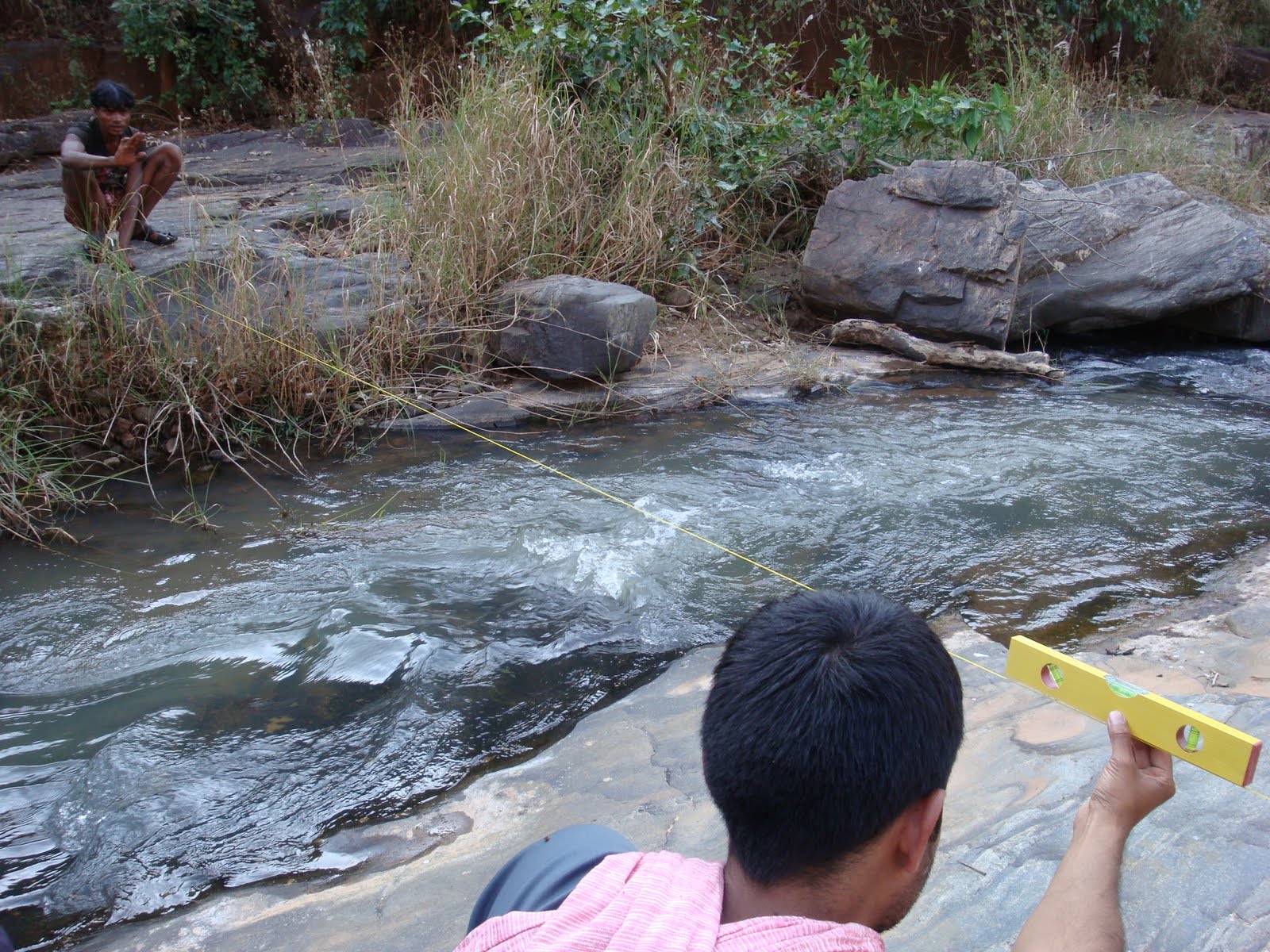
The water flow varies from 80-100lps, depending on the water use of the upstream village and seasonal changes:


Our new team member (holding the level) and an old friend, Ranjit Deshmukh, has been the technical lead for this project. With four existing projects to improve and implementing two new projects in parallel, needless to say, my plate has been full. Therefore, Ranjit's presence has been priceless in ensuring that we do not make technical mistakes (or at least do not repeat mistakes form earlier projects).

As a newbie to micro hydro implementation, Ranjit's key role is to learn from our Sri Lankan mentors and demystify the knowledge for the local team, consisting of technicians in Bhawanipatna (nearest town) and talented youth in the villages.


See the bamboo stick? The task of preparing the bamboo to use as a measurement tool became an opportunity for the village youth to bond with our team:


Richard Russell, a volunteer from the UK, helped with note taking:


A channel, likely made from HDPE or PVC pipe, will extend from the weir to the forebay tank:


The forebay tank will be located on top of the flat stone on the right:


The HDPE penstock will have to be routed from the forebay tank location to the powerhouse via the stone walls. ....Yes, challenging work ahead!


After the first 100m, the penstock will have a nice, boring path thru the woods and on soil...


...down to the powerhouse location:


During one of our visits, when all the adults were busy with their harvesting, 3 young guides were sent to make sure we didn't get lost. These three kept an eye on us the entire visit, whether nearby or from a distant rock.


Saturday, April 10, 2010

The Week in Review

Lots of loading and un-loading this week in transporting oil presses from Bhawanipatna to micro hydro sites (electricity-based livelihoods activities).


At Amathagouda micro hydro, there is never a dull moment. Every time we fix one thing, something else goes wrong. Now that we've almost finished replacing the old school pulley to pulleys that are easier to remove, we discovered a pipe leak.


The leak is due to a dried up rubber gasket at a joint located between 2 beautiful anchor blocks, next to a mango tree. The system also needs a bypass line. So the solution: cut the pipe (instead of destroying the blocks) to change the gasked and add a bypass line.

Tuesday, July 15, 2008

Rural Youth

With every field visit, I realize that the greatest opportunities for improving life in poor rural communities are in the hands and hearts of the rural youth. If the strengths of rural youth are tapped, harnessed, and enhanced, wonders in rural infrastructure, social tensions, and plain happiness can manifest into present and future generations. Here are some images and contemplations:


A young boy from Lineguda gets creative with left over house wiring materials.


Padme Dewa, from REDCO, teaching the Purna Guma youth how to install insulators.


This is Hira on the right looking at Padme Dewa's sketches. Hira has extraordinary strengths in making things happen, IF he really wants them to happen. He was the one that led the brick-making efforts, while everyone else (mostly the oldsters) wanted GV to buy from the outside. Thanks to Hira's leadership, Purna Guma's youth self-help group fund has gone up by Rs. 7000. GV bought the bricks for the powerhouse from the youth.


Here is Hira again, one of the 3 three that had been on the poles, installing cables on a day that turned out to pour.

Despite the rain, Hira and the others did not want to stop until the line was finished.

My last time in Purna Guma, a couple of days ago, has me in waves about Hira. The last time we visited was Padme Dewa's last day in the village for a while and Pobitro Dada's (the guy building the turbine assembly in town) first day. P. Dada has been wanting to go to PG for the longest time. He has become passionate about the project. Finally we took him. ....However, the visit was a bit sour. When we drove into PG that day, Hira and the rest had been installing more
poles.

The same day was the closing ceremony of the famous Rath Yatra festival. Someone joked that they had never attended but this year Gram Vikas would take us to Karlapat to attend the festival. Hira said we'll be ready. You take us. I took it as a joke. As we were leaving the village, I saw that Hira was waiting for us, all bathed and dressed to go to the festival. GV has a policy of not using its vehicles for anything other than work. I also did not want to start any prohibited habit...although I am guilty of taking women and children in our vehicle if they need to visit the hospital and if our vehicle is going to B.Patna regardless. In the case of taking village boys to attend the Karlapat Rath Yatra, Hira put me on the spot. He went to the point of saying, "If you don't take us, don't expect anymore work from us." While this was supposed to be a special visit for Padme Dewa and Pobitro Dada, Hira's ultimatum chased away the warm and fuzy feelings. In the end, I tried to explain that I did not have the authority to use the vehicle for pleasure and that our guests had not had lunch when it was already 4p. (Not having meals on time is a recipe for malaria.) We did not take them...and I left Hira quite disappointed. It is Hira's stuborness that I have admired in the project, as well as the element that put me on the spot. I want to approach it with love and openess. ...Unfortunately, I cannot return to Purna Guma for another few days....I am wondering whether I should go hang out with him first, feel out his mood and attitude about continuing with micro hydro. Or should i simply ignore the his disappointment. I feel that my taking villagers every now and then in the vehicle set the scene for the Hira incident. Likewise, my reaction to Hira's changed mood will set the scene for the next "situation".


Rashmi-- in the orange, Hira's friend, and a respected school teacher--has been the lead youth in helping to organize and mobilize the community to implement Purna Guma without GV staff. As I left the village last time, I mentioned the Hira incident. He said, "Don't worry so much."


Monday, July 07, 2008

Lessons Galore

What great lessons I've learned in the past few weeks!

1. In India, never give a small order to a large company--it may not come thru.
4 months ago we ordered 2 motors for Purna Guma from Kirloskar, an extremely huge industry name. They could not deliver even though we had given an advance. It was a combination of low quality operations, communications, and maybe even not having the motor we needed. I couldn't clearly conclude. Thanks to a friend's reference, we were able to find another supplier.

2. In India, plan 5 times the ideal time required.
Having ordered the motors with a small-scale and referred supplier, they were shipped within 2 weeks of sending an advance payment. BUT thanks to the nation-wide truck strike, the motors were delayed for a week, sitting in the middle of rural Andra Pradesh. Finally, today I got word they have reached their destination. Of course, it will take another few days to get GV's act together in: deciding on the best vehicle to transport the motors (one that than can outsmart the state tax collectors), finding someone besides me to accompany the motors, and finding another vehicle to bring it 12hrs out to Kalahandi district. The logistics story never seems to end....

3. Avoid villagers that like to talk a lot and ride with you in vehicles.
I have been astonished at how some in the village work non-stop. They are usually the quiet and straight forward personalities, often the poorest. However, there are always the 1 or 2 that love giving themselves pats on the back, travelling with you to project some image to their counterparts, etc. Still, I am seeing everyone in the Purna Guma community transforming. Even those that talk more than work have enhanced their skills and understanding one another. The toughest social situations always turn out to be great opportunities.

4. Child labor, village accidents, and plug points.
The hardest lesson this week was realizing after it was too late that while us oldsters (about 15 of us over 15 years of age) sat around at the end of the work day, the only one of us working was Ramesh, seven years old. He kept going on with shoveling the chips for concreting. Until this awakening, I perceived child labor in the Purna Guma project to be voluntary. I finally realized that just because kids were having fun with the work did not mean they were volunteering their efforts. ...Actually, it could be either way. There are kids that skip school in order to see what's going on with the project and then there are others that come only after school. The non-tribal community members blamed the tribal (who are the poorest) families for sending their kids to contribute labor. Labor contribution, as well as a monetary contribution to the corpus micro hydro fund, allows a family in Purna Guma to benefit from the micro hydro project.

I asked why they would send their kids instead of coming themselves. The answer was simple: the adults were busy with fieldwork. Fieldwork allows them to feed their kids. However, the non-tribals hire the tribals to do their fieldwork. Yet, they said, "The tribals are only good for drinking." At this point, I understood that child labor in this project was intertwined with caste culture. ...But I still couldn't sit around with my malaria and let Ramesh do the work, while the rest of watched. Yet, I did not want to impose my values on the community. I have learned in previous projects that it is no good to preach without action. ...Still, I couldn't hold my words. They came out, "Isn't Ramesh your son too?" "How can we let such young kids do the work of adults, as we sit and watch?" Several nods came...and along with a sense of regret.

A few minutes later walking back to the jeep, I stopped by the first house, a tribal house. Went in to say hi and found out that the lady of the house had been in a brutal accident. In Kalahandi, like many rural parts of India, villagers give their labor to generate income. The laborers are often transported in open trucks and tractors. This lady had fallen out of a tractor, broken her shoulder and bruised her skull. A woman that was healthy and perfect the last time I saw her, now was half bald with a deep cut on her head, along with a drooping shoulder. Just then our all-star Jaysingh Babu (non-tribal) walks up to the house to check in on her. He has been the light of the project, always positive and supportive no matter who is working with him. He said no one wanted to touch the lady when the accident happened. "There was blood everywhere. She is tribal. But she is still of our sister. We took her to the hospital. It's a miracle that she is living now. We are lucky." The reason she was sending her young kid to work was because her older son was too busy taking care of her health.

Plug points. Everyone in Purna Guma wants plug points, in addition to lights. However, to limit the number of plugpoints and to fairly charge for the extra consumption of electricity, the plug point requires a one-time Rs. 500 fee, in addtion to the Rs. 1000 contribution to the corpus fund and double tariff. Yogesh, the young and nimble all-star worker from the Lineguda hamlet mistakenly got a plug point wired at his house...of course he likes it and of course no one will be rude and take it away from him now that it is installed. ....Yogesh' youngest kid, 6 months old, has a blown up belly. His mom says, "He has had constant diarrea for several months." I ask Yogesh when he would take him to the doctor in Bhanvanipatna. He says when he has money. ....Earlier, Jaysingh had explained that he spent Rs. 500 on his son's broken arm bills. .....I guess it's getting to me that GV wants to charge extra for plugpoints when we have such a huge project budget and we've been good about streamlining the design and minimizing the expense. Of course, nothing should be given for free...but why are we creating the burden of luxury?

Sorry for the incoherency. Will try again on this topic and others with a clearer mind.

Saturday, July 05, 2008

Thursday, May 01, 2008

Facilitating Locals to Develop Micro Hydro

One key aspect of the Purna Guma micro hydro is the creation of local developers. There are two main lessons that has led Gram Vikas to facilitating the creation of local micro hydro developers:

1. The previous projects were done using developers from Delhi and Bangalore. Once the developers receive their payments, they do not stick around, especially in malaria infested Kalahandi, Orissa. They are always willing to have assistance by phone/email...but in the end it is really discouraging for villagers to keep trying to troubleshoot when they haven't been given any training. For instance, we've had to fix the Karlapat gate valve on our own multiple times since its commissioning 1.5 yrs ago. A few months ago the shaft of one of the turbines had sheared, with no clear explanation. It took 2 months to repair. Such events affect the people's faith in the technology.

2. In the past GV micro hydro staff have been part of a special project syndrome. Since the micro hydro projects are pilot projects, they are seen as very special. Indeed 24hrs of clean electricity is special, but in the case of our staff, he feels he has to prove what he knows. In reacting to their insecurities, GV micro hydro staff failed to facilitate villagers to hold their own meetings, to do simple trouble shooting, and simply to emotionally own the system. In the end the staff leaves because he has come down with malaria too many times, and villagers have no choice but to take on the staff's technical and social duties. The villagers that have taken on the responsibilty of keeping the system alive are a handful of individuals which were voted to be the micro hydro committee. In the end, when the entire village hasn't gone thru the process of taking managment and technical responsibilities gradually, they end up chastising the committee and viewing Gram Vikas as an electric company that maintains the micro hydro. We have worked hard in the previous project to break this cycle of shunning responsibility...still, often the old mindset creeps in.
Having learned from the above two lessons, Gram Vikas is taking on a new approach to community-based micro hydro in the case of the Purna Guma project:

1. Design and manufacture the turbine and controller locally
With the help of Practical Action, we are transferring the know-how of building micro hydro turbine and controller to Bhavanipatna, a town 1hr away from the micro hydro villages. No more need to eternally wait for Bangalore/Delhi based developers for repair work. The villagers can take a bus to Bhavanipatna and meet the manufacturer in person. We've come across a very sincere and excited machine shop owner in Bhavanipatna, Pobitro Dada, who I am already seeing blossom into a local turbine developer.

He has an electrical engineer friend who we are hoping will learn how to build controllers. The only remaining task to localize is the civil works. Vaishnav Singh from the Karlapat system can transform into a civil works expert, already being involved with Purna Guma construction and local government buildings.
2. Faciliate mentoring between experienced villages and new villages
Vaishnav Singh and Anand Singh from the Karlapat system have been mentoring Purna Guma from the early stages. Essentially the social mobilizing that was done by GV staff is now being done by local leaders. It has worked wonderfully, especially since Vaishnav and Anand have gone thru difficult times and know in hindsight how certain processes, e.g. group meetings, corpus collection, recording trouble shooting in log books, etc. can chance the course of a micro hydro project.

The vision is to have the social and technical leaders of each micro hydro project form a cooperative. This would allow locals, who have no choice but to live in these remote areas, to drive the development process and also can make an income by implementing micro hydro for their region's villages. There is a new site in sight--Pui Guda. Beautiful dark rock and falling water. I am hoping Vaishnav Babu will form a team and will implement the project on his own.
3. Faciliate the community to manage and drive the construction process
Despite Vaishnav Babu serving as the consultant of the civil works at Purna Guma, the community is blessed with 3 hamlets that each have very pro-active leaders who always thinks 2 steps ahead. There have been so many pleasing instances in the last 2 months (the construction period) where Purna Guma has shown that they will lead their own construction. While I continue to try and convince Karlapat to bury it's penstock (it's been 2 years!), Purna Guma leaders were lecturing to us about making the sure pipe is buried to prevent damage from UV rays and falling rock. In addition to Purna Guma having innate qualities of leading the project, not having any GV engineer on-site has made a huge difference. Although I have an engineering degree, Purna Guma is the first time I've managed any hands-on construction. The villagers see how little I know...and they know there is no one else. So they pester Vaishnav Babu and the masons for answers. They also learn from their own experience. The best part has been to watch them thru their mistakes. They never get discouraged; they simply try again and again until they get it right. For instance, we were measuring and cutting rods for the channel. They knew how long the rods needed to be, but they kept mis-reading the measuring tape which did not consecutively mark inches (e.g. the 13th inch was labled as 1", since the foot was already noted). Jay Singh Babu, the best of the leaders, kept making the same mistake...but not once did he get upset or give up. ...I guess surviving in the forest gives such people great energy to be persistent.

Sunday, April 27, 2008

Penstock woes...or opportunities?

Based on my experience with Gram Vikas' micro hydro, I would say that the penstock laying of a micro hydro system is the most challenging task of implementing a micro hydro system. Severe leaks in the Karlapat system delayed the commissioning by nearly a year! The second system also has leaks. Yesterday, we started the laying of the penstock of the 3rd system, Purna Guma. Bad planning on my part. I was hoping that the remaining tasks--turbine, transmission, etc.--could be done in parallel in the next week...but there are delays in getting the engineers at the site. And due to communication issues, I did not know of the delays until after the penstock supplier reached Kalahandi. ...Therefore, we have a half-done penstock that will cook in the sun until the rest of the tasks can be finished. ...The woes of working with multiple organizations and suppliers...not to mention my reactive emotions....are making my life far from boring.


Un finished installation of gate valve...


The supplier we are using did wonders in fixing the Karlapat leaks, and therefore we chose to use him for Purna Guma. He had come a week earlier to finalize Purna Guma plans with the Practical Action engineer. Plans were finalized but as he started the work, it was not according to plan. We had marked a penstock pathway with the engineer and the villagers. Some goat went away with the string marking, so the villagers guessed and made the 3'x1' path required by the supplier. Luckily their guess was correct, but the supplier wanted to add additional bends when they were not required, simply so that he could finish faster. Also, the villagers worked very hard to make the path, but in hindsight, I don't think the path was needed! As you can see in the photos, it would have helped to have 1' of land to lay the penstock on...


I am bit concerned about the gradual bends...I guess PVC allows this. We'll see when we test for leakage. The earlier marked path by the Practical Action engineer had no bends...


Since I'm complaining, I might as well explain how the supplier keeps going back and forth on whether we should put anchor blocks now or later. Since I questioned his decisions, he decided most of the remaining work on the line should not be finished until the Practical Action engineer arrives.


This supplier is really trustful...but the way he managed the villagers on this project was disappointing. He expected villagers to be out at 5am, as Jaysingh Babu is in this photo, but he himself wanted to leave the site early when villagers were still ready to work. (Every outsider who visits ends up wanting to leave as soon as they come...Maybe it's the remoteness; usually it is that they are a little sick and develop some phobia to stay. I need to find a solution for future visitors.) Villagers have their regular routines so that they can fit into the day all the various tasks they need to do just to survive. They have to take their animals out, do seasonal house repairs, prepare the fields, go to town, maintain their tools. Although these tasks sound simple, they all consume great time. When you require a village to break that routine, it's awful. Usually they end up over working their bodies. Low immune systems in malaria infested Kalahandi is bad news. ...And of course the supplier will be long gone when the villager has to deal with the dilemma of spending the money to visit a doctor 2 hrs away...or just let the malaria take care of itself...Lame. ...I have yet to meet any supplier in India that doesn't make my temperature go up. ....yes, I am breathing and calm...now :)


Because the supplier couldn't get the rated pipes we wanted (10kg) in time (although now we have an extra month thanks to the Practical Action engineers not being able to come and my needing to be in the US for a few weeks), we were forced to get more expensive pipes (12-14kg).


The rising Sun makes all woes disappear...


The guy with the head gear is one of the best mobilizers in the community. He's loud and happy :). I have much to learn from him.


...Not sure why we have to use fiberglass coating for the pipes....If these systems are meant to help the climate change struggle, we need to be examining what parts of the system also contribute to environmental woes, e.g. fiberglass coating, cutting trees for pipe supports, etc.


Fiberglass roll...This saved us in the last project where there were severe leaks due to the penstock being out of spec. ..but I wasn't expecting this to be used in the project. ...It's hard to change the dynamics once work starts...unless I really get my temper out in the open.

For now, I can only take these lessons as opportunities to do better in the next project. ...I shouldn't be so hard on the supplier. He's has been passionate about helping us with the previous leaks (now another older project has leaks), but it is difficult to work with his logic.

I am finding myself in extreme emotions these days. I can't seem to deal with lack of perfection in others...even though I completely lack perfection! I can't deal with the communication gaps, e.g. when people say one thing and do another. I let the negative emotions get the best of me. It is only when a villager at the site sees me that I change a little. ...Usually the older ones know when I am down. I become their daughter for a few moments....tremendous Love is transferred in those few seconds and I feel rejuvenated. Thank you, Universe. I am grateful.

Finishing of Forebay tank

...All site efforts organized by the village construction team...no Gram Vikas field engineer required :)


Silting wall


Plastered and pretty!